Repointing
Appropriate where stones remain stable but exposed mortar joints have deteriorated.
Many older stone foundations were built from irregular stone and lime-rich mortar, so a rough surface can be normal. More important warning signs are progressive bulging, loose or displaced stone, deep mortar loss, recurring water entry and cracks or movement that continue to change.
These wall types are common across Atlantic Canada. DinoMac's field examples come from PEI, while the same stability, moisture and repair principles apply to traditional stone foundations in many older buildings.
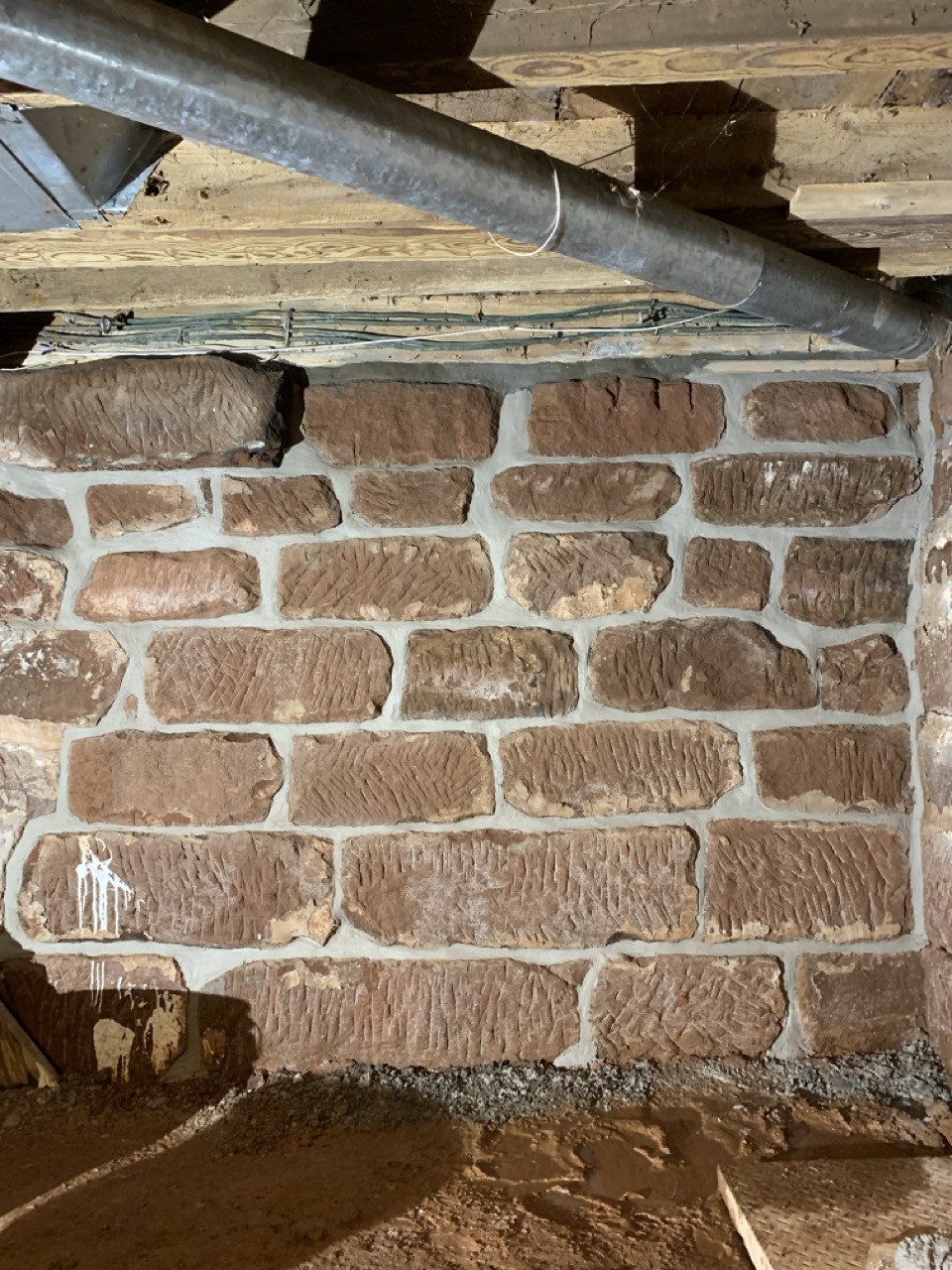
Traditional stone foundations can contain large exterior and interior stones with smaller stones, mortar and fill occupying the wall core. The exact construction varies by building, but the wall often depends on the combined mass and interlocking of many individual units rather than on a single monolithic material.
That is why deep mortar loss can matter even when the largest stones have not visibly moved. Mortar loss can allow smaller packing stones to loosen, increase water entry and reduce the wall's ability to behave as a coherent assembly.
It also means that applying a smooth interior parge coat can change the appearance without necessarily telling you what is happening deeper inside the wall.
A stable wall with weathered joints may primarily need repointing. A wall that has changed shape, lost bearing or developed a growing bulge needs a different level of investigation.
Historic stone walls were not built to look like modern concrete. Uneven stone sizes, irregular joints and a rough interior face can be completely normal. The concern is whether stones are becoming loose, the wall is bulging, cracks are increasing or mortar is disappearing deeply into the wall.
Water entry can also reveal weaknesses, particularly where exterior grade, drainage or downspouts allow water to remain against the foundation.
The U.S. National Park Service's Preservation Brief 2 specifically warns that repointing alone will not correct masonry deterioration caused by leaking drainage systems, settlement, rising damp or severe weather exposure. The underlying cause should be addressed or the deterioration can continue after the new mortar is installed.
Canada's Standards and Guidelines for the Conservation of Historic Places recommends maintaining the building envelope from roof to foundation, ensuring positive drainage away from foundations and retaining structural systems that can be repaired rather than replacing them unnecessarily.
Those principles are useful even on an older house that does not have a formal heritage designation: understand the wall, correct the water path, preserve sound masonry and intervene only as much as the condition requires.
U.S. National Park Service: Repointing Historic Masonry →
Parks Canada: Standards and Guidelines for Historic Places →
The repair has to match the condition behind the visible face.
Appropriate where stones remain stable but exposed mortar joints have deteriorated.
Individual stones can sometimes be reset where local movement or mortar loss has loosened them.
Bulged or unstable sections may need to be dismantled and rebuilt rather than simply pointed over.
Some wall types may contain internal voids or lost core material that require a repair approach beyond face pointing.
Grading, drainage and roof-water discharge can be just as important as the masonry repair itself.
Significant structural movement, major displacement or uncertainty about stability may require an engineer as part of the repair process.
More than one condition can exist at the same time, so this is a practical starting point rather than a diagnosis from a distance.
Repointing may be the main masonry repair if the wall remains plumb and individual stones are still well seated.
Selective resetting, repointing and replacement of lost packing material may be appropriate depending on the depth of deterioration.
The affected masonry may need to be carefully dismantled and rebuilt rather than simply pointed over.
Inspect exterior grading, downspouts, roof runoff, cracks, open joints and drainage conditions before assuming the interior wall surface is the source.
Ongoing movement deserves investigation. Significant changes in wall shape, bearing or the structure above can justify engineering review.
The parge coat may be showing movement or moisture from the masonry behind it. Recoating the same surface does not necessarily address the underlying condition.
Poor grading, short downspouts, blocked drainage and snow accumulation can keep water against lower masonry. In winter, wet foundation materials are also exposed to freezing near grade.
Correcting these conditions can reduce future deterioration and may be necessary before interior finishes or coatings are considered.
Start with the simplest observable water sources: roof runoff, downspout discharge, ground sloping toward the building, hard surfaces directing water to the wall, blocked drainage and areas where snow accumulates against the foundation. The goal is to reduce how much water the masonry has to absorb and manage.
The cause of a damp basement wall may be easier to understand by examining the roof drainage, ground slope and exterior masonry than by looking only at the interior stain.
Parging can protect and tidy appropriate masonry surfaces, but it should not be confused with structural stabilization. If stones are loose, the wall is bulging or deep mortar has been lost, the underlying masonry needs to be addressed first.
Dense paints or waterproof coatings also deserve caution on older masonry. If water continues to enter from outside or below, a low-permeability interior coating can conceal dampness or change where moisture accumulates.
When moisture is the concern, identify how water reaches the wall and how the wall historically dried before deciding whether a coating is part of the solution.
A mason can identify many visible masonry conditions, but significant movement may involve soil, footings, framing, concentrated loads or changes to the building's structural system. Those conditions can require a structural engineer to determine why the wall is moving and what support or sequencing is appropriate.
Engineering review becomes especially useful where movement is substantial or accelerating, a wall has a major bulge, bearing has been lost, floor or framing movement is visible, or the proposed repair will change how loads are carried.
Temporary support, excavation sequence and the relationship between the foundation and the structure above can matter as much as the masonry rebuilding itself.
These examples show why support conditions and the work being done around the foundation matter as much as the visible wall surface.
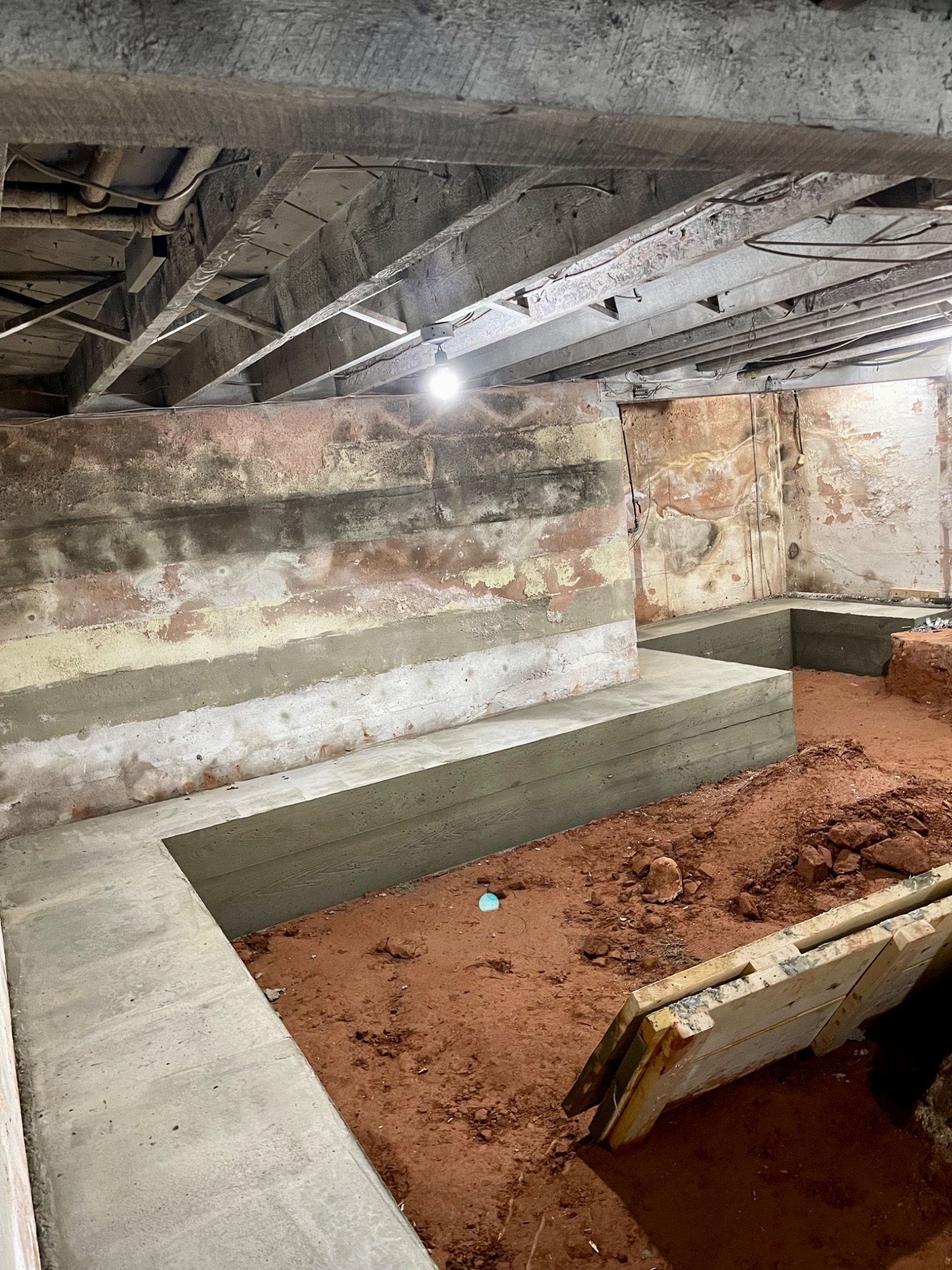
Basement lowering: this bench footing was built so the basement floor could be lowered without undermining the existing foundation. Work that changes support conditions should be planned as structural work, not cosmetic masonry repair.
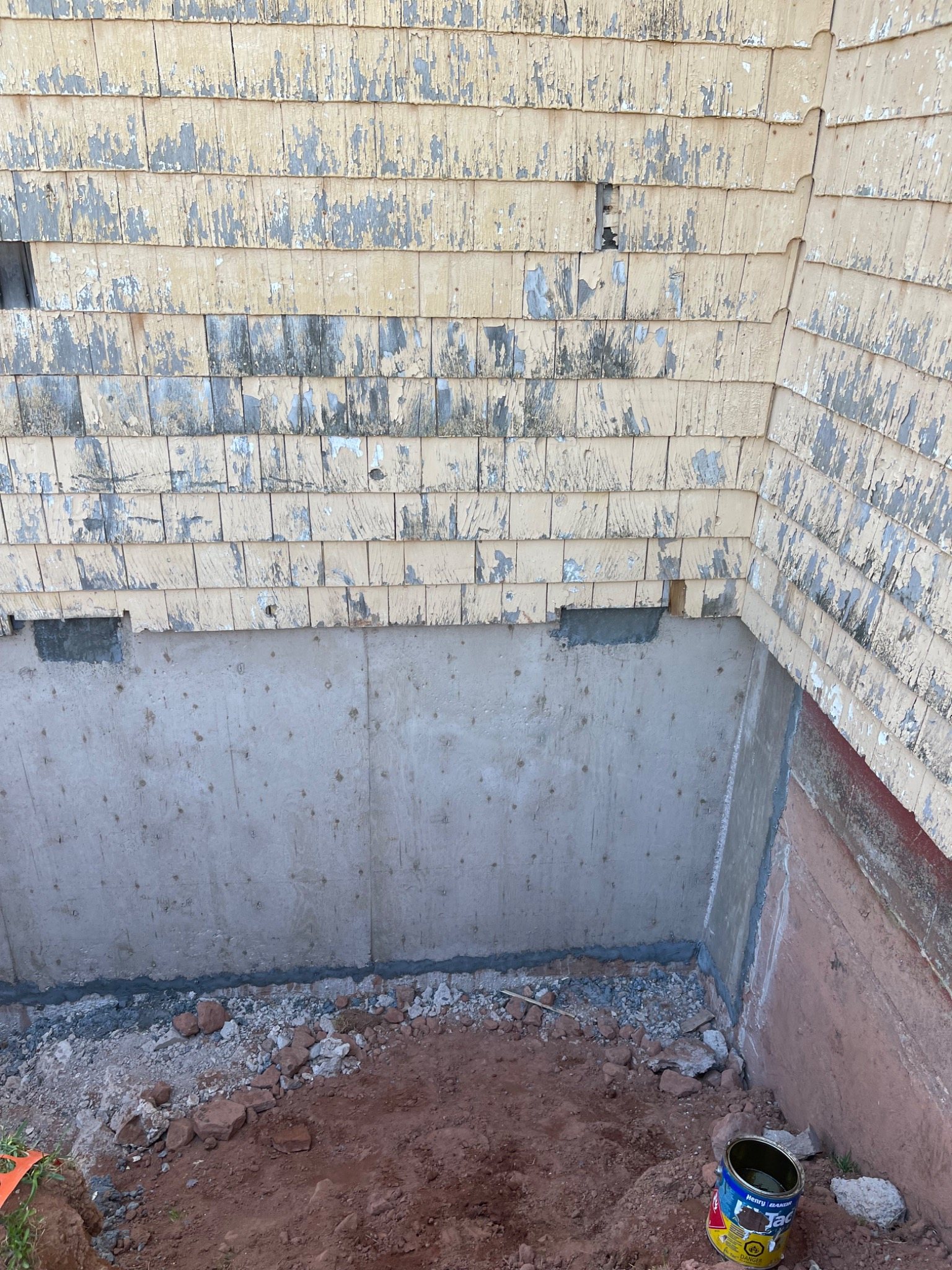
Collapsed wall beneath a church steeple: after extensive shoring, the failed block section was removed and replaced with a 10-inch reinforced concrete wall tied into the remaining foundation. The retained cinderblock was filled with Sika 212 grout.
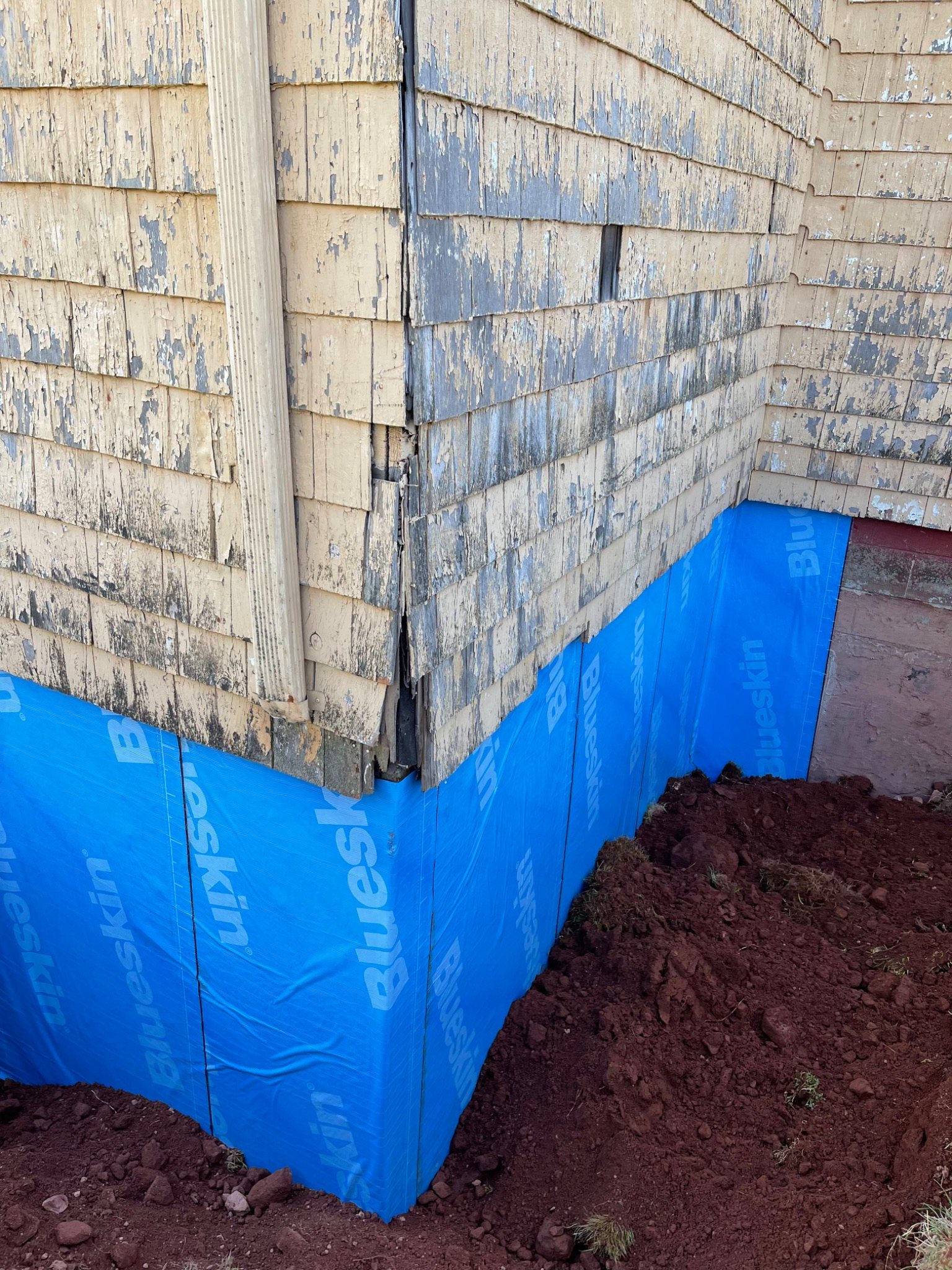
Structure and water management are separate steps: after the structural foundation repair, an exterior membrane was added before backfilling to improve water control at the repaired wall.
If a condition is not immediately dangerous, dated photographs and simple measurements can help show whether movement is continuing. New cracking, widening joints or stones becoming loose are reasons to reassess the wall.
This guide combines hands-on masonry experience with recognized technical and conservation guidance. DinoMac's field context comes from Prince Edward Island, while the underlying repair principles are useful across Atlantic Canada and other cold, wet climates.
Dean is a third-generation mason with more than 20 years of hands-on experience working with brick, natural stone, chimneys, foundations, repointing and masonry restoration in Prince Edward Island.
Last reviewed: August 26, 2026
No. Older stone foundations are often irregular by design. Stability, progressive movement, loose stone, mortar loss, water behaviour and change over time are more useful indicators than appearance alone.
Not by itself. Repointing repairs mortar joints. A wall that is bulging, leaning or actively moving may require stabilization, selective dismantling and rebuilding, or structural review depending on the cause.
Common contributors include poor grading, short downspouts, roof runoff, exterior soil moisture, open joints, cracks and drainage conditions. The exterior water source should be investigated rather than relying only on an interior coating.
No. Sound mortar can remain. Repointing should focus on deteriorated joints and use a mortar compatible with the existing stone and wall construction.
Parging can protect or finish an appropriate surface, but it does not stabilize loose or moving masonry. The underlying wall condition should be addressed first.
Significant or accelerating movement, large bulges, major cracking, loss of bearing, uncertain stability or repairs that alter the load path can justify structural engineering review.
Send photographs of the full wall, the affected area, exterior grade and any nearby downspouts or drainage conditions. Significant movement may require an on-site review.