Chimney Crowns
Cracked or flat crowns can allow water into the top of a chimney and the masonry below.
A damp wall, spalled brick or leaking chimney may be the symptom, not the source. Durable masonry repairs look at where water enters, how it moves through the assembly, where it should drain and whether the wall can dry afterward.
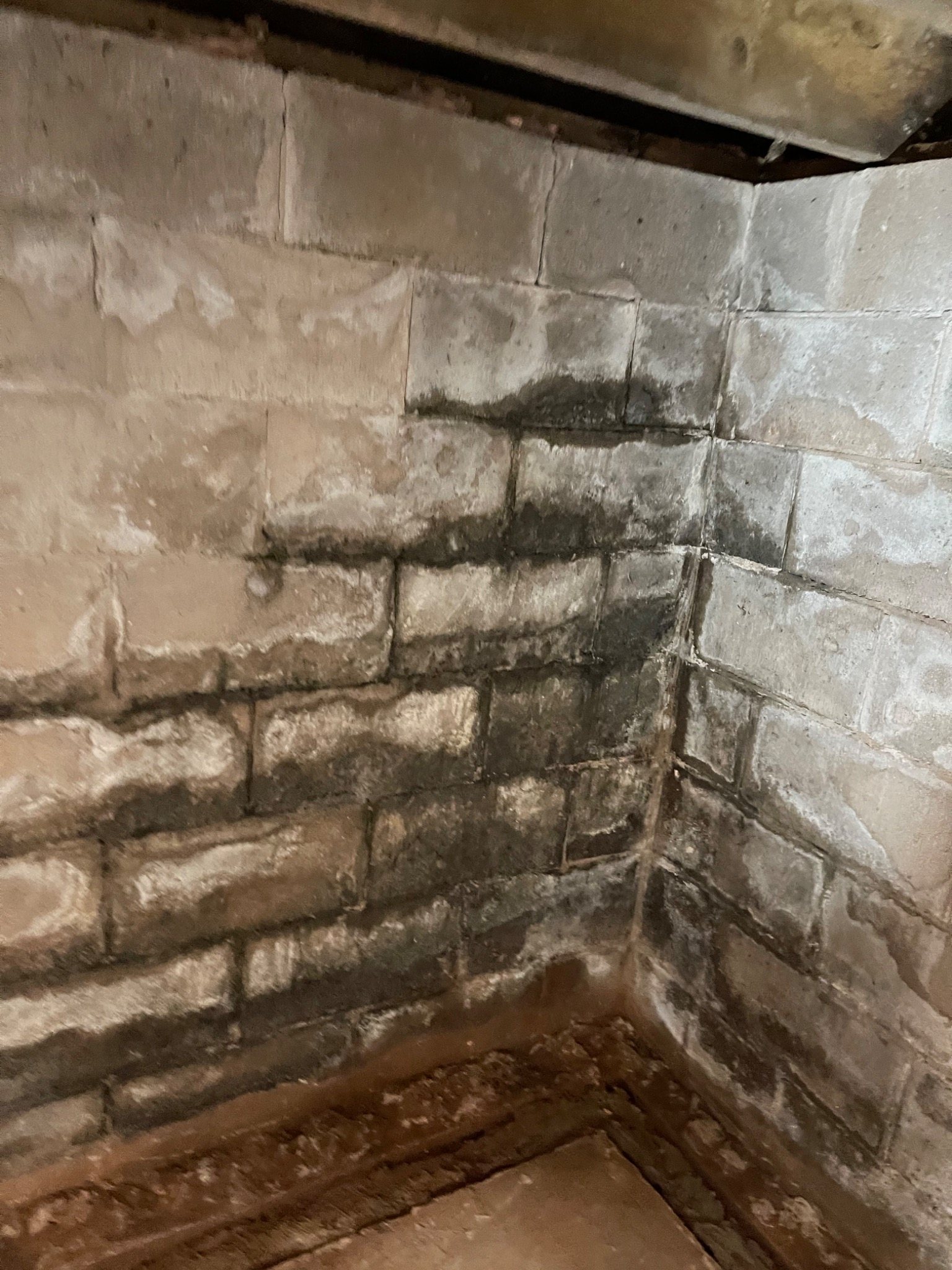
Interior staining is a symptom, not the source. The visible wet area helps locate the problem, but diagnosis still has to consider exterior grade, drainage, wall construction and water paths above or beside the stain.
Masonry is not normally treated as an absolutely waterproof outer shell. Brick, stone, mortar joints and the many transitions around openings can absorb or admit some moisture. Modern wall assemblies are therefore designed to manage incidental water and direct it back outside.
Water can move by gravity, capillary action through porous materials, wind pressure during storms, or along concealed interfaces such as flashing and cavities. In older solid masonry walls, the wall may also rely on its thickness and ability to absorb and later release moisture.
National Research Council Canada research on rain penetration in masonry notes that design details and workmanship strongly influence resistance to rain. That means a water problem cannot be diagnosed by looking only at how absorbent the brick or stone appears.
National Research Council Canada: Rain Penetration and Design Detail for Masonry Walls →
Cracked or flat crowns can allow water into the top of a chimney and the masonry below.
Roof-to-wall and roof-to-chimney junctions rely on correctly detailed flashing to remain watertight while materials move.
Damaged or poorly sloped horizontal masonry can direct water back into the wall.
Deeply weathered joints create direct paths for water and can allow more saturation during storms.
Cracks through brick, stone, mortar or concrete can admit water and may also indicate movement that needs investigation.
Poor grading, splash-back and drainage can keep foundations and lower walls wet for long periods.
The place where water becomes visible is not necessarily where it entered. A more useful diagnosis asks four separate questions: where can water enter, what route can it follow through the wall, where can it collect, and where was the assembly intended to drain or dry.
This matters in both modern drained veneer walls and older solid masonry. The details differ, but in either case a stain can be downstream from the actual defect. Repairing only the wet-looking joint can therefore miss the source.
Building Science Corporation describes brick veneer and other claddings as materials that can allow water through under real weather exposure. The protection comes from the wall assembly behind the cladding: a continuous drainage plane, integrated flashing, drainage space and outlets that allow water to move downward and back outside.
This is particularly important around windows, doors, roof intersections, ledges and the base of walls. If flashing is missing, damaged or blocked by mortar, water can remain trapped in the assembly or be redirected inward.
Older solid masonry walls work differently from modern drained veneer walls, so repair details should respect the actual wall type rather than assuming every brick wall has the same construction behind it.
Many exterior wall systems contain cavities, flashings and drainage paths intended to manage incidental moisture. When those details are working, water may enter the outer masonry without immediately appearing indoors.
That delay can create the impression that deteriorated joints or cracked masonry are harmless because the interior is still dry. By the time staining appears, deterioration may already be well established.
Open joints, failed sealant transitions, damaged crowns, loose units, staining and recurring wet areas can all justify investigation before interior damage develops.
Water follows gravity, pressure differences and concealed pathways. The pattern of the leak can often narrow the likely source before any masonry is opened. Keep in mind that not every wet masonry condition begins as rain penetration: ground moisture, capillary rise, condensation and plumbing or roof drainage can create different wetting patterns.
Note whether the leak occurs during light rain, long-duration rain, wind-driven rain, snow melt or only after freeze-thaw conditions.
Mark the location and height of staining or dampness. Water can travel before appearing, so the visible spot becomes a reference point, not an automatic diagnosis.
Look at roof edges, flashing, chimneys, window heads, sills, wall caps, penetrations and cracks that could introduce water upstream of the stain.
Weeps, cavities, flashing laps and exterior grade can fail even when the visible masonry face looks relatively intact.
A leak that appears only with wind from one direction can indicate an exposure-sensitive opening or transition rather than generalized masonry porosity.
Repainting or patching the interior first can hide the evidence needed to confirm whether the exterior repair actually solved the problem.
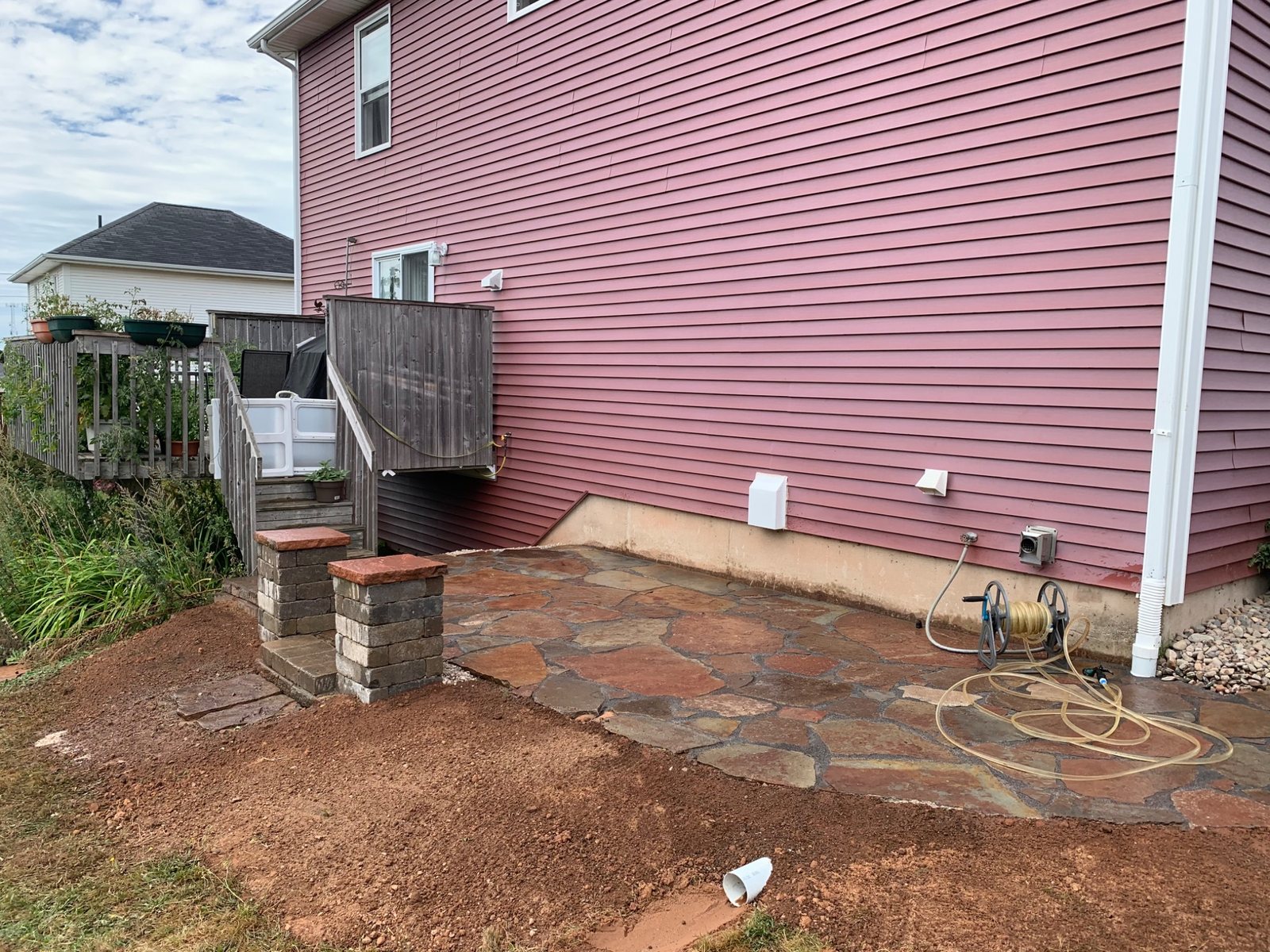
Drainage before patching: on this project a downspout was dumping water at the building corner and moisture was appearing inside. The work combined a flagstone patio and walkway with a drain and grading changes so water would shed away from the foundation.
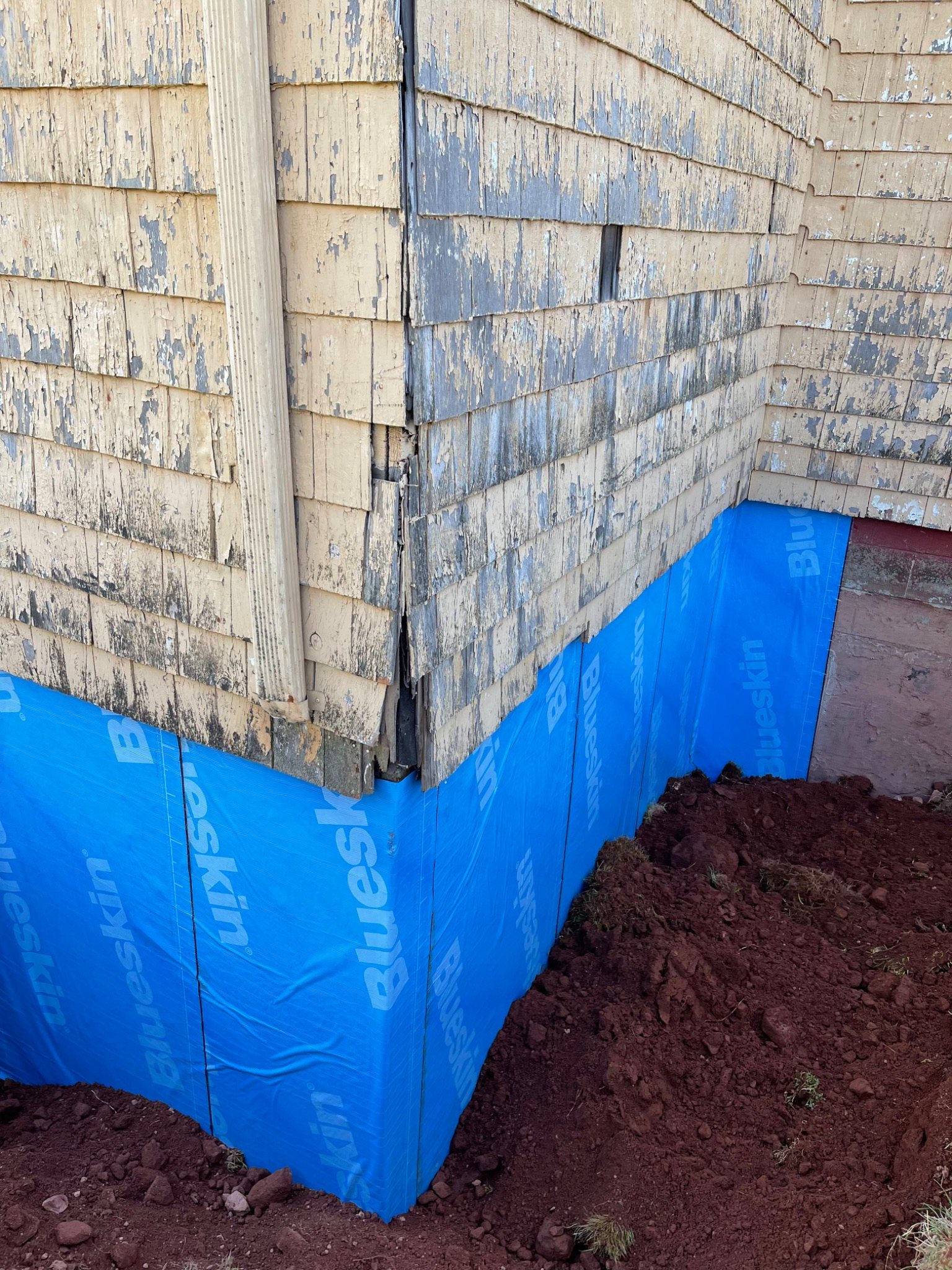
Exterior water control: this membrane was installed after a major structural foundation repair. It shows why waterproofing is most effective when it is part of a complete exterior repair rather than a coating added to a wet interior surface.
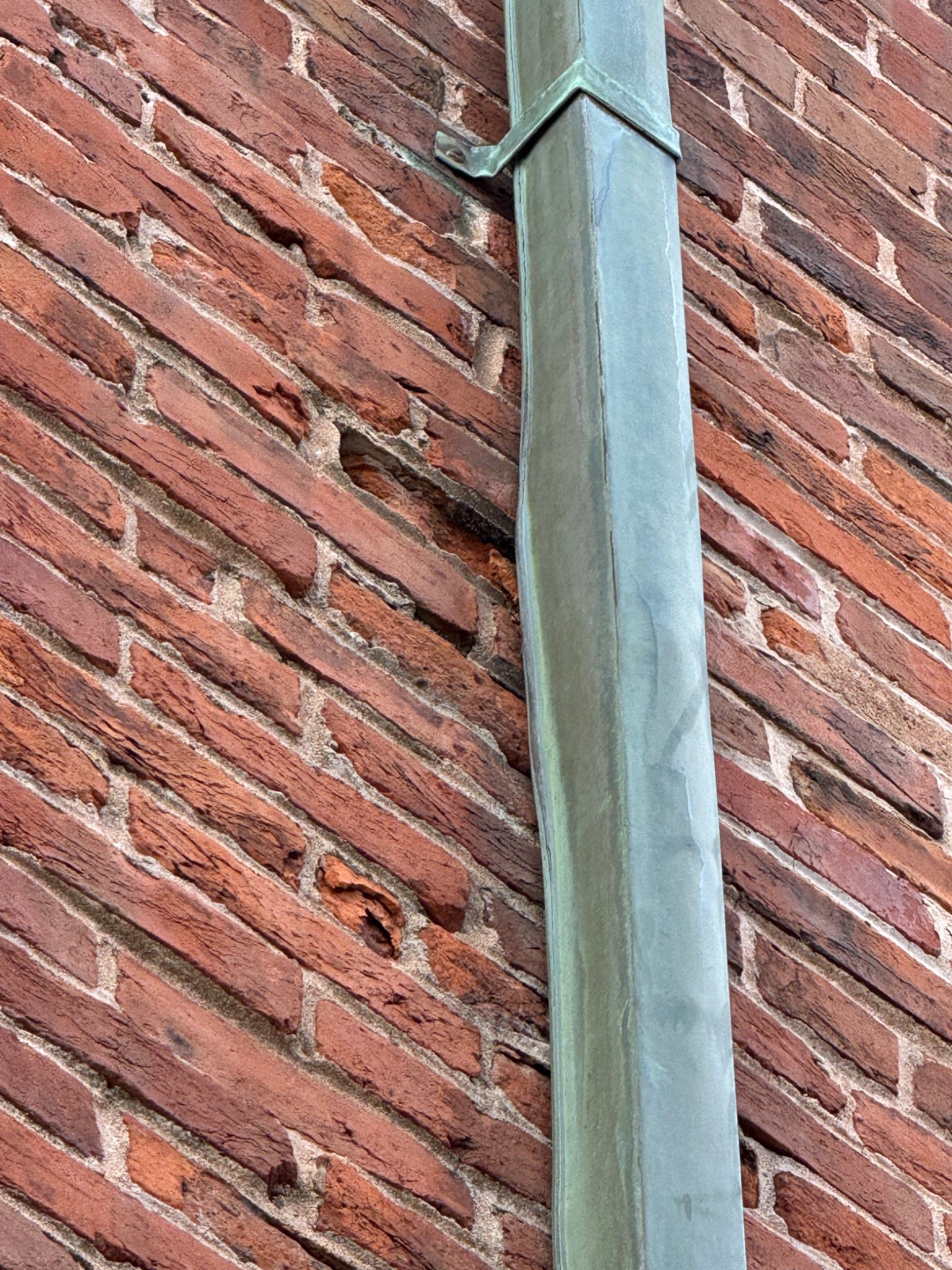
Follow the water source: brick deterioration beside roof-drainage components is a reason to inspect how water is being collected and discharged before treating the masonry face alone.
Once water enters masonry, repeated freezing can accelerate cracking, mortar loss and spalling. The combination of moisture and winter exposure is one reason chimneys, parapets, sills and foundations can deteriorate quickly in PEI conditions.
Simply sealing the face of a wall is not always the answer. Some coatings can trap moisture, and a surface treatment cannot repair failed flashing, open joints or structural cracks.
For a deeper explanation of why saturated masonry is vulnerable during Island winters, see DinoMac's Freeze-Thaw Masonry Damage guide →
A wall should be able to shed liquid water while still allowing normal moisture movement. Repair materials and coatings should be chosen with that balance in mind.
Efflorescence forms when moisture dissolves soluble salts within masonry or mortar, carries them toward the surface and then evaporates, leaving the salts behind. The white deposit is therefore often a clue about moisture movement rather than the primary defect itself.
The National Park Service notes that moisture-related salts can damage masonry if crystallization occurs within the pore structure rather than harmlessly on the surface. Cleaning the deposit without understanding the moisture source can therefore treat the symptom while leaving the cause in place.
Efflorescence should also be distinguished from other deposits or staining. If the material or cause is uncertain, avoid aggressive cleaning methods that could damage the masonry face.
New landscaping, blocked gutters, recent repointing, a roof leak, winter saturation or changes to interior heating and drying can all alter moisture movement through a masonry wall.
Water can travel along flashing, framing, cavities and masonry before appearing at an interior finish. Diagnosing the source may require looking above and beside the visible stain, not just directly outside it.
On chimneys, for example, the crown, cap, flashing, masonry and roof junction should be considered together.
The National Park Service's moisture guidance for historic buildings emphasizes diagnosis before treatment because there is rarely one universal solution. Location, climate, soil, groundwater and building construction all influence how moisture behaves.
National Park Service: Controlling Unwanted Moisture in Historic Buildings →
The National Park Service advises that water-repellent treatments are often unnecessary on well-maintained historic masonry and that they cannot correct leaking roofs, failed gutters, missing mortar, cracks, rising damp or other sources of unwanted moisture.
Even vapour-permeable water repellents reduce drying to some degree. If liquid water continues to enter the wall from another path, a treatment can change where that moisture accumulates. Film-forming or impermeable coatings can be especially problematic on masonry that needs to release moisture.
A treatment may have a role on specific sound masonry after testing and diagnosis, but it should come after physical repairs and water-management defects have been addressed.
National Park Service: Water-Repellent Treatments for Historic Masonry →
Buildings across PEI and Atlantic Canada can experience strong wind-driven rain, snow accumulation, coastal exposure and repeated winter freeze-thaw cycles. Walls and chimneys that stay wet longer have less opportunity to dry before temperatures drop.
This makes details such as chimney crowns, flashing, wall caps, sills, grade-level drainage and roof-water discharge important not only for leak control but also for long-term masonry durability.
The best repair therefore considers both the immediate symptom and the building detail that allowed repeated saturation to occur.
This guide combines hands-on masonry experience with recognized technical and conservation guidance. DinoMac's field context comes from Prince Edward Island, while the underlying repair principles are useful across Atlantic Canada and other cold, wet climates.
Dean is a third-generation mason with more than 20 years of hands-on experience working with brick, natural stone, chimneys, foundations, repointing and masonry restoration in Prince Edward Island.
Last reviewed: August 28, 2026
Not necessarily. Failed flashing, open joints, cracks, roof drainage, sills, crowns and penetrations are common entry paths. The source should be diagnosed before applying a coating.
Not automatically. Impermeable coatings can trap moisture or shift where water accumulates if the real entry path remains. Physical defects and drainage problems should be addressed first.
It is often efflorescence, created when water carries soluble salts to the surface and then evaporates. It is a useful clue that moisture is moving through the material.
Wind direction, rainfall intensity, duration and wall orientation can expose openings that remain dry during ordinary rain. That pattern can help narrow the likely water-entry location.
It can help when open mortar joints are a significant entry path, but repointing will not correct failed flashing, a cracked crown, blocked drainage, structural cracks or roof-water problems.
Masonry that remains saturated can be more vulnerable when temperatures drop. Repeated wetting and freezing can accelerate mortar loss, spalling and deterioration of exposed units.
Send photographs of the interior symptom and wider exterior views showing the wall, roofline, chimney, sills, grade and nearby drainage. The wider context often helps identify the likely water path.
The Armoury repair found that support and water management were interconnected. Existing lintels tipped inward, weep vents were missing, and the window perimeter sealant required renewal, so the repair addressed each path rather than treating only the cracked brick.
See the Armoury water-management repair →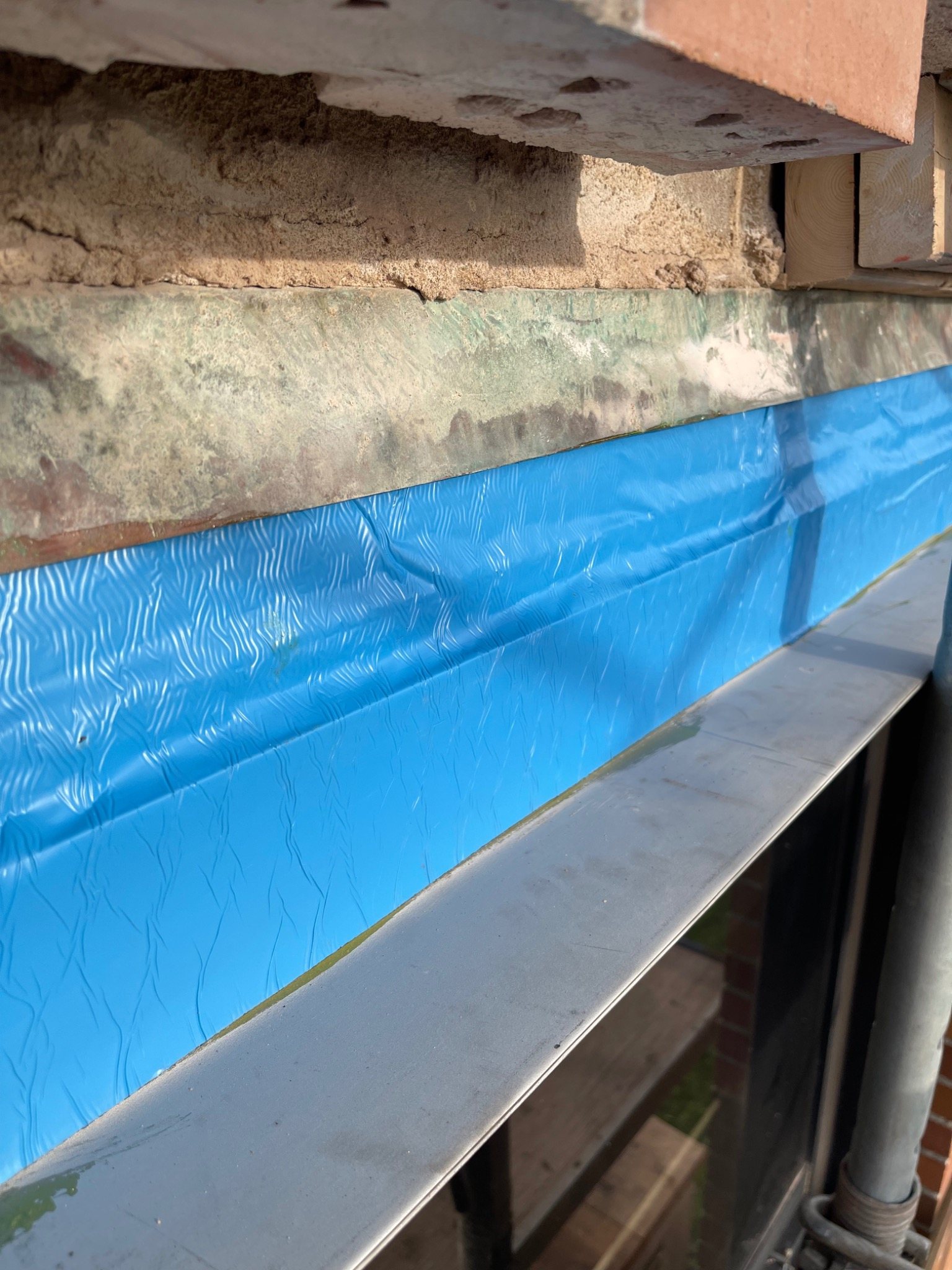
Field example: new stainless lintel, primed membrane flashing and retained through-wall copper flashing at a repaired brick opening.