Reuse original fieldstone
Original stone from failed sections was retained, sorted and reused so repaired areas continued to read as part of the century-old monument rather than as replacement masonry.
The stone monuments surrounding Notre-Dame-du-Mont-Carmel Church are more than decorative masonry. They are part of the parish's Acadian history, and the main arch is a cenotaph commemorating local soldiers who died in the First and Second World Wars.
DinoMac was brought into the community restoration campaign to repair deteriorated fieldstone masonry, stabilize failed sections, reconstruct lime-mortar coping elements, address hidden internal washout caused by water infiltration, and help preserve as much original material as practical.
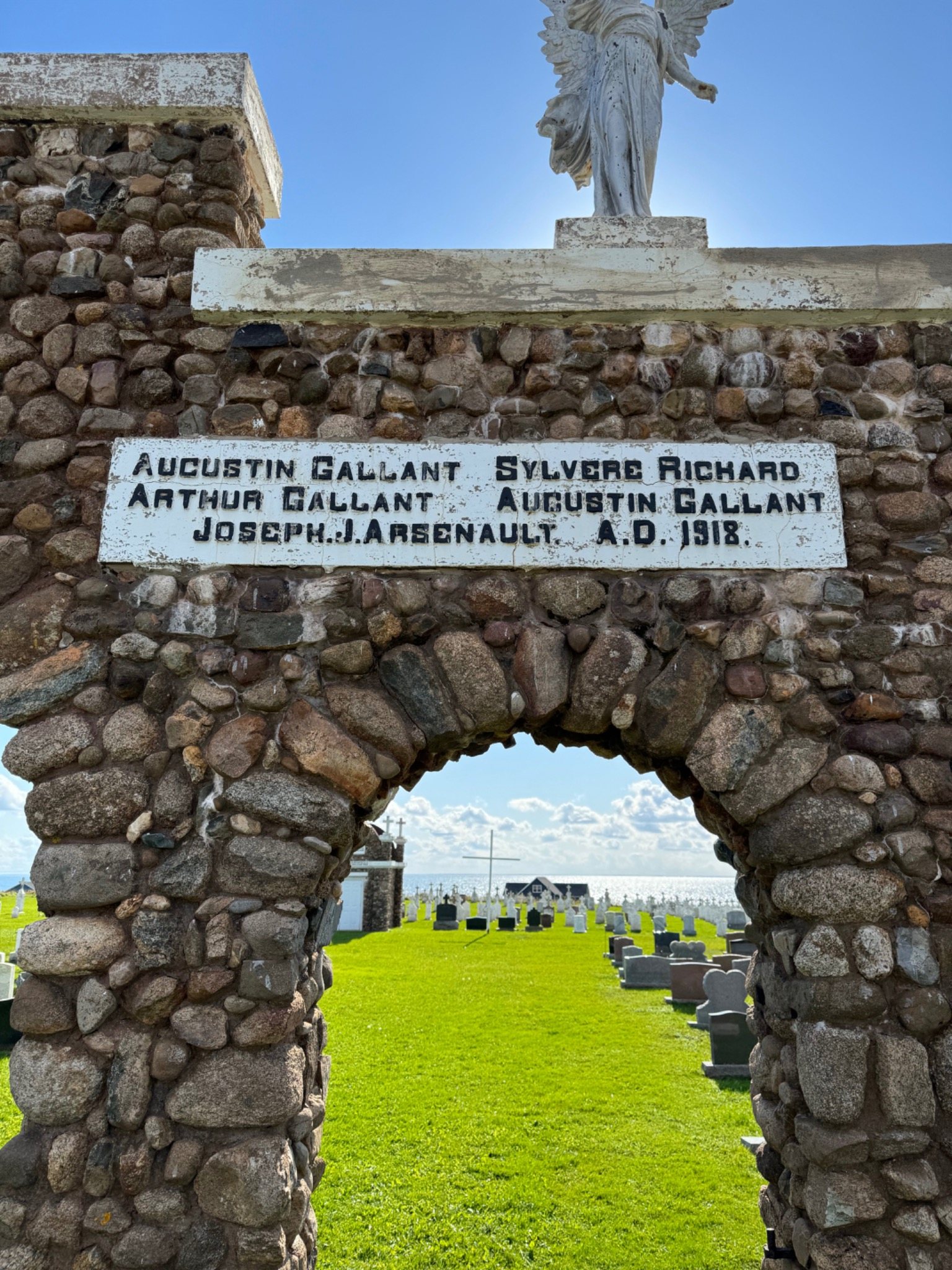
The main arch serves as Mont-Carmel's cenotaph. Veterans Affairs records that it was unveiled in August 1923 and later received the trumpeting angels, cross and Second World War memorial plaque.
Public records document a four-monument restoration campaign involving three stone arches and a mausoleum, all built in the 1920s by Acadian mason Cajétan Arsenault.
La Voix acadienne documented that the unusual fieldstones were apparently supplied by parishioners at the request of Father Pierre-Paul Arsenault. The monuments were constructed by Cajétan Arsenault, and their fieldstone character is especially distinctive on an Island better known geologically for sandstone.
The restoration campaign described the site as four significant stone monuments: three arches and a mausoleum. The main arch, built in 1923, serves as a cenotaph for Mont-Carmel soldiers who died during the two World Wars.
For DinoMac, that history made retention of the original stone a central part of the repair. Where failed portions had to be rebuilt, the original stones were reused rather than replaced simply for the sake of making the repair look newer.
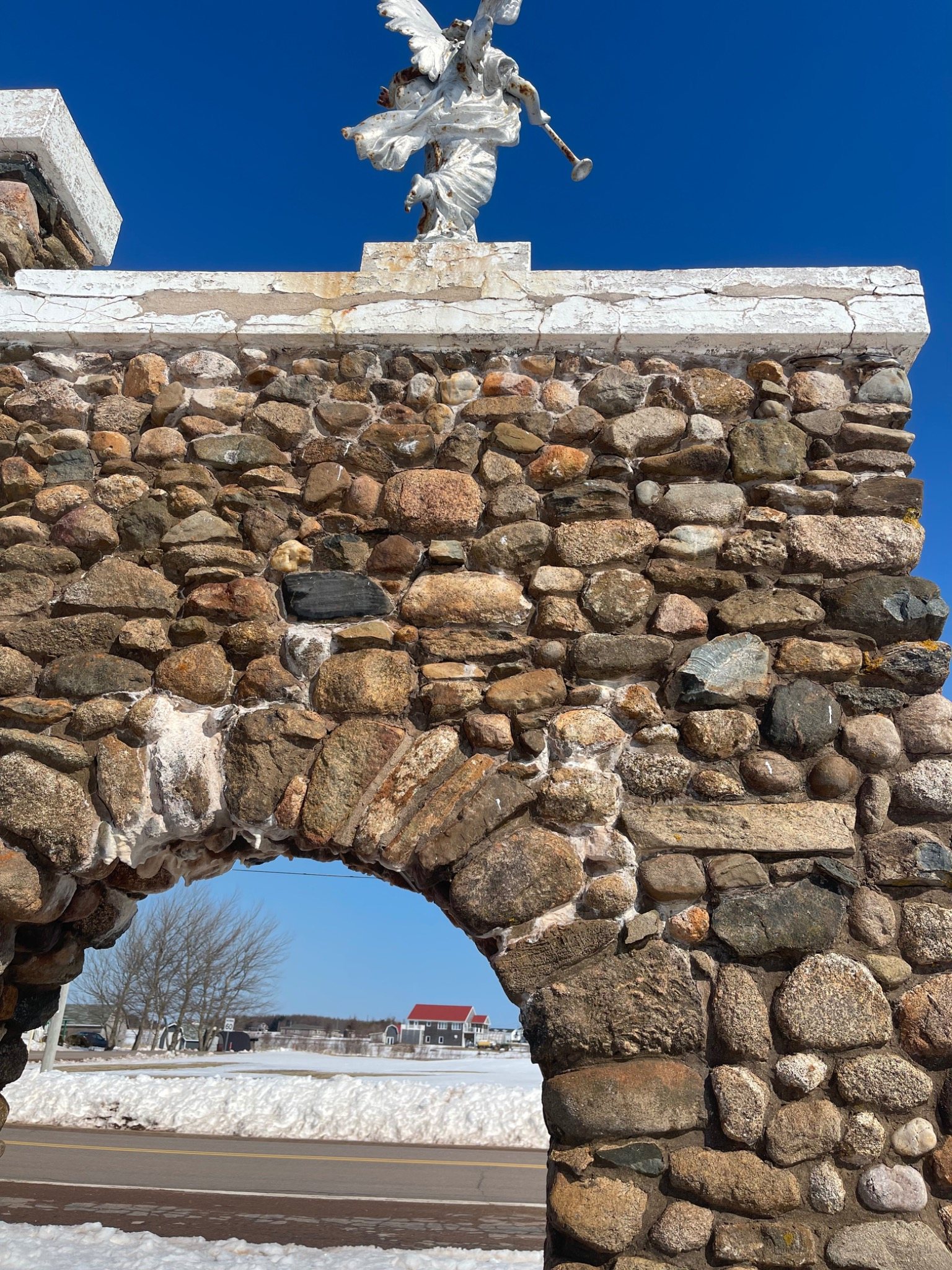
Original construction: the monuments combine irregular fieldstone, carefully fitted arch work and lime-based decorative or coping elements.
The visible loss of mortar and stone was only part of the problem. Water infiltration had also washed material from internal areas, leaving significant voids that reduced the solidity of the bases.
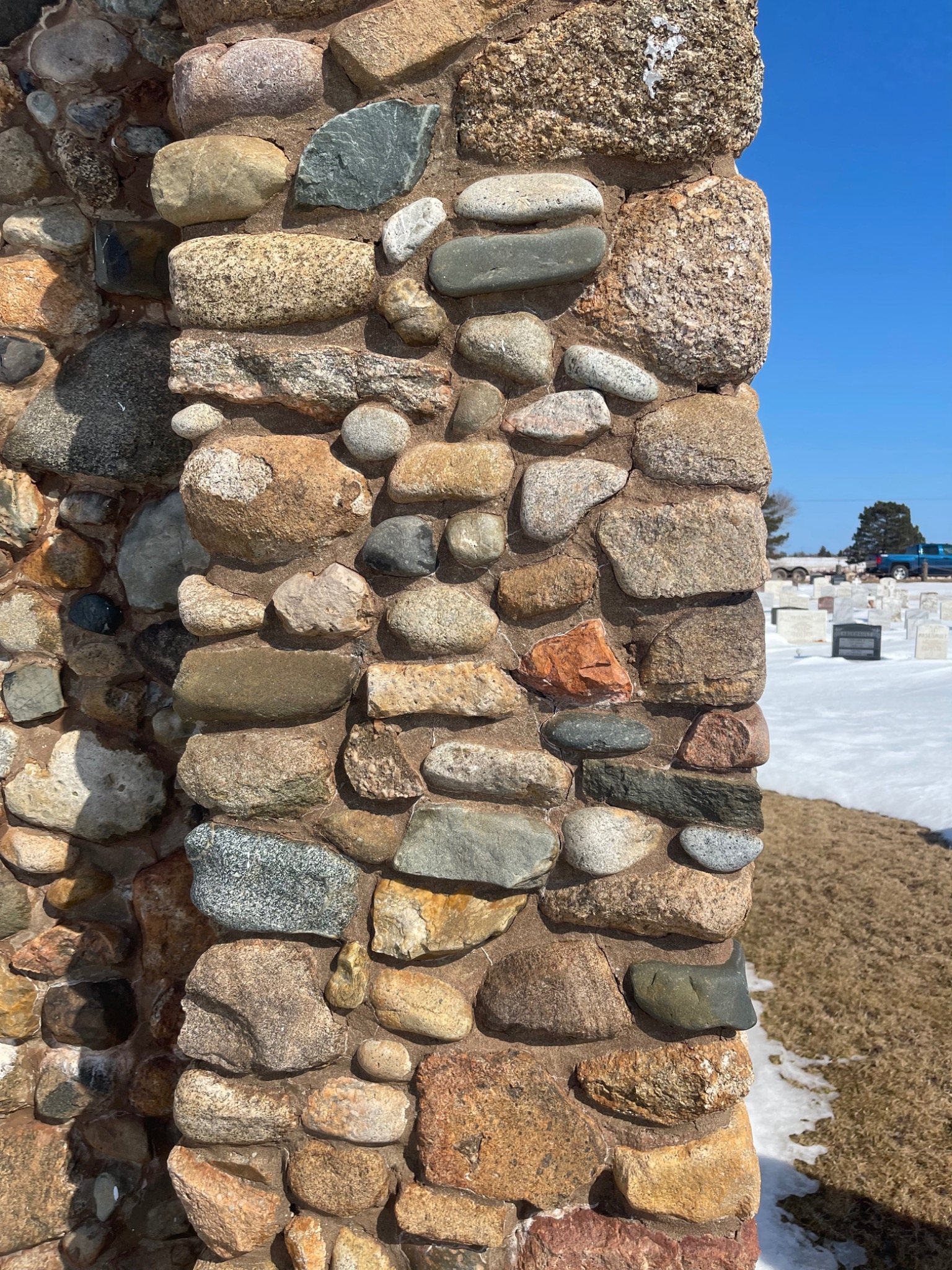
Weathered joints: open and deteriorated mortar allowed more water to enter the fieldstone masonry.
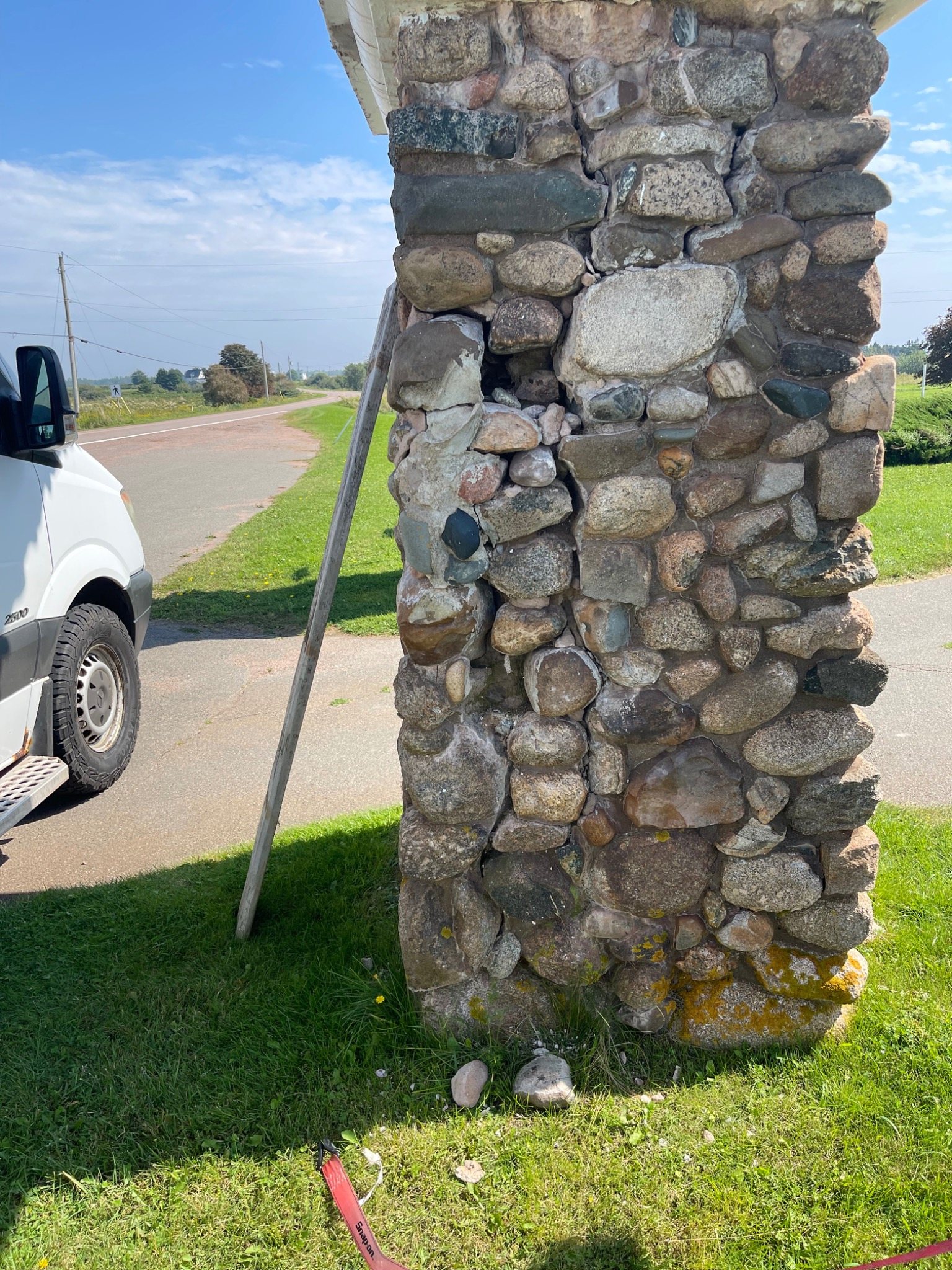
Failed corner: original stones had loosened and the damaged area exposed voids within the monument.
The repairs combined traditional material compatibility with discreet stainless-steel reinforcement where added connection was needed.
Original stone from failed sections was retained, sorted and reused so repaired areas continued to read as part of the century-old monument rather than as replacement masonry.
A failed corner of the main monument was rebuilt with the original stone. Stainless-steel spiral helical masonry ties were incorporated to add concealed connection between the reconstructed section and surviving masonry.
Where water had washed out material within the monument bases, new repair mortar was pumped into the internal voids to re-solidify the assemblies rather than treating only the visible outer joints.
The original coping material was lime-mortar based. A compatible lime repair product was selected and damaged sections were reconstructed, with stainless-steel anchoring incorporated where required.
Vulnerable joints at the transition between the fieldstone masonry and coping elements were sealed where water had been entering, reducing the opportunity for future water to reach the monument interiors.
Statues and coping elements were cleaned and repainted, and restoration work also addressed the war memorial plaque so the masonry stabilization and memorial presentation were completed together.
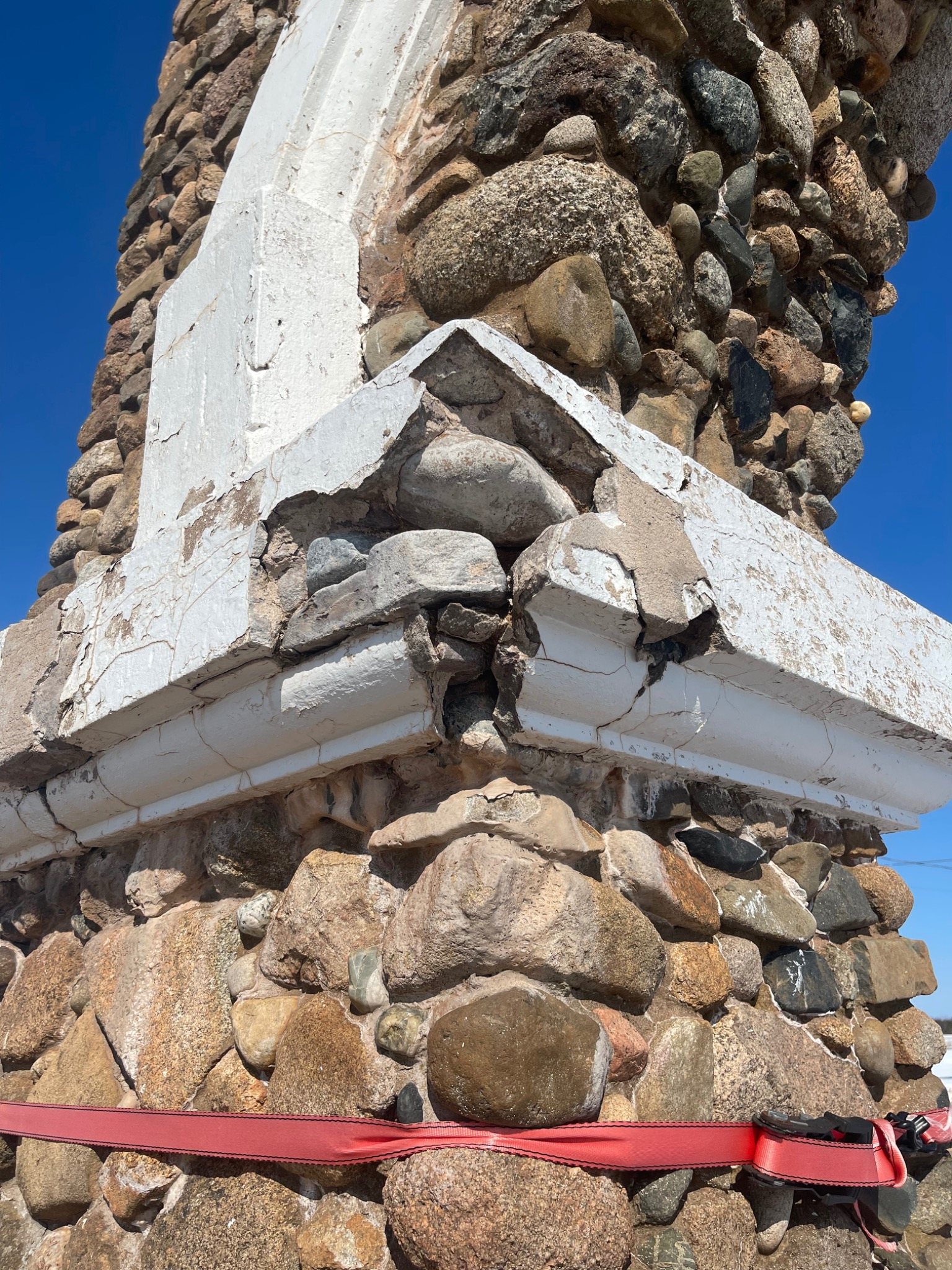
Controlled rebuilding: damaged sections were supported while loose masonry was addressed and original stones were prepared for reuse.
The corner repair illustrates the balance required on heritage masonry. Simply packing mortar into the open face would not have dealt with the failed stonework, but replacing the corner with modern block or new stone would have unnecessarily removed original fabric.
The damaged area was therefore rebuilt with its original fieldstone. Stainless-steel spiral helical ties were incorporated within the repair to improve connection to the surviving masonry while remaining concealed once the stonework was completed.
The visible result remains a fieldstone monument. The reinforcement works behind the face rather than becoming a new visual feature.
The coping elements were not simply modern concrete caps. Their original material was lime-mortar based, so the repair needed a product and finish compatible with that historic construction.
Damaged coping sections were reconstructed using a matching lime-based repair mortar and stainless-steel anchoring. The copings were then cleaned and repainted as part of the overall restoration.
Just as importantly, the interface between the stonework and the coping was treated where water had been getting inside. Reducing that recurring water entry was essential because the internal washout had already shown what repeated infiltration could do over time.
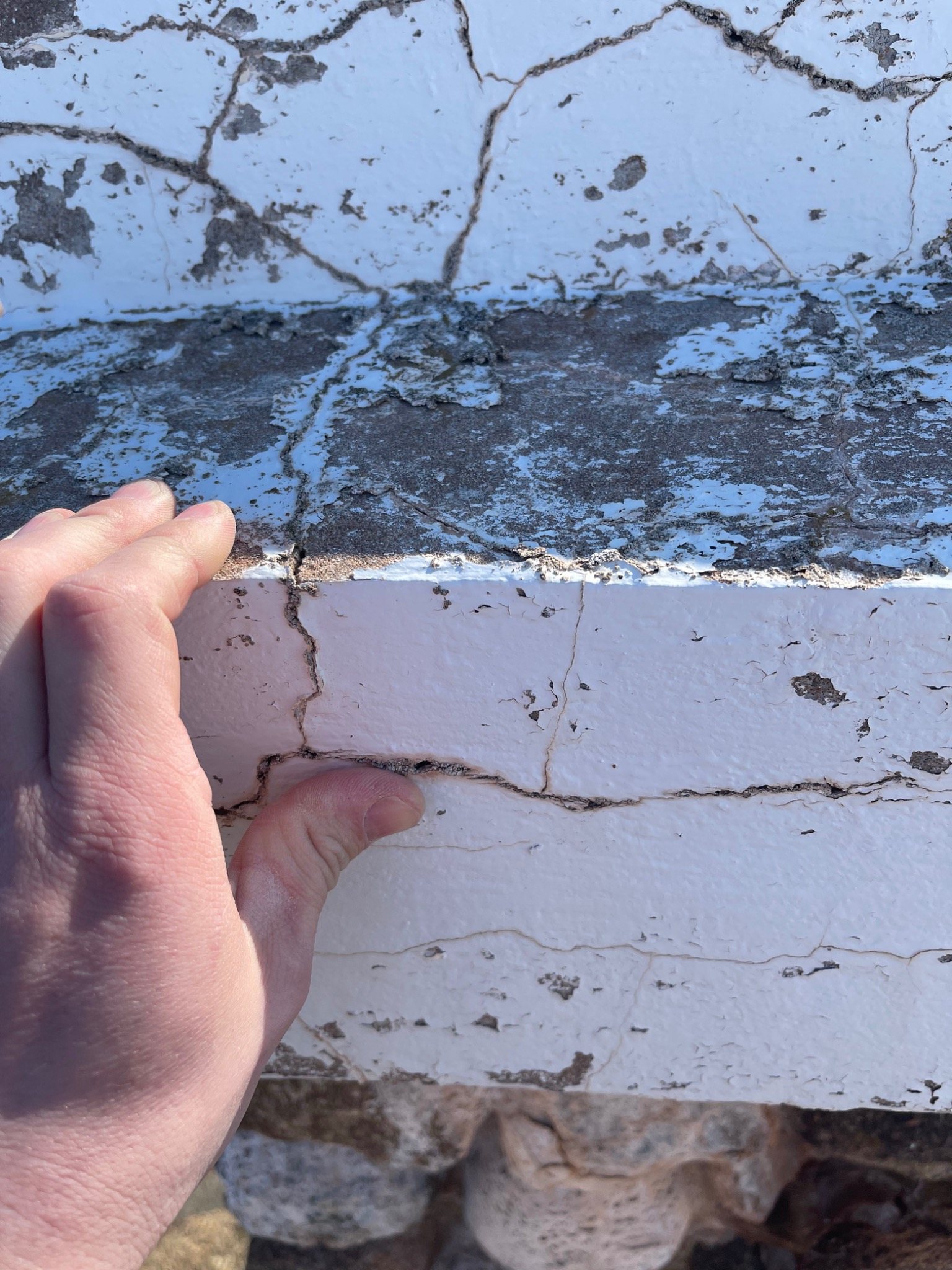
Coping deterioration: cracked and weathered material created vulnerable paths at the top of the monument.
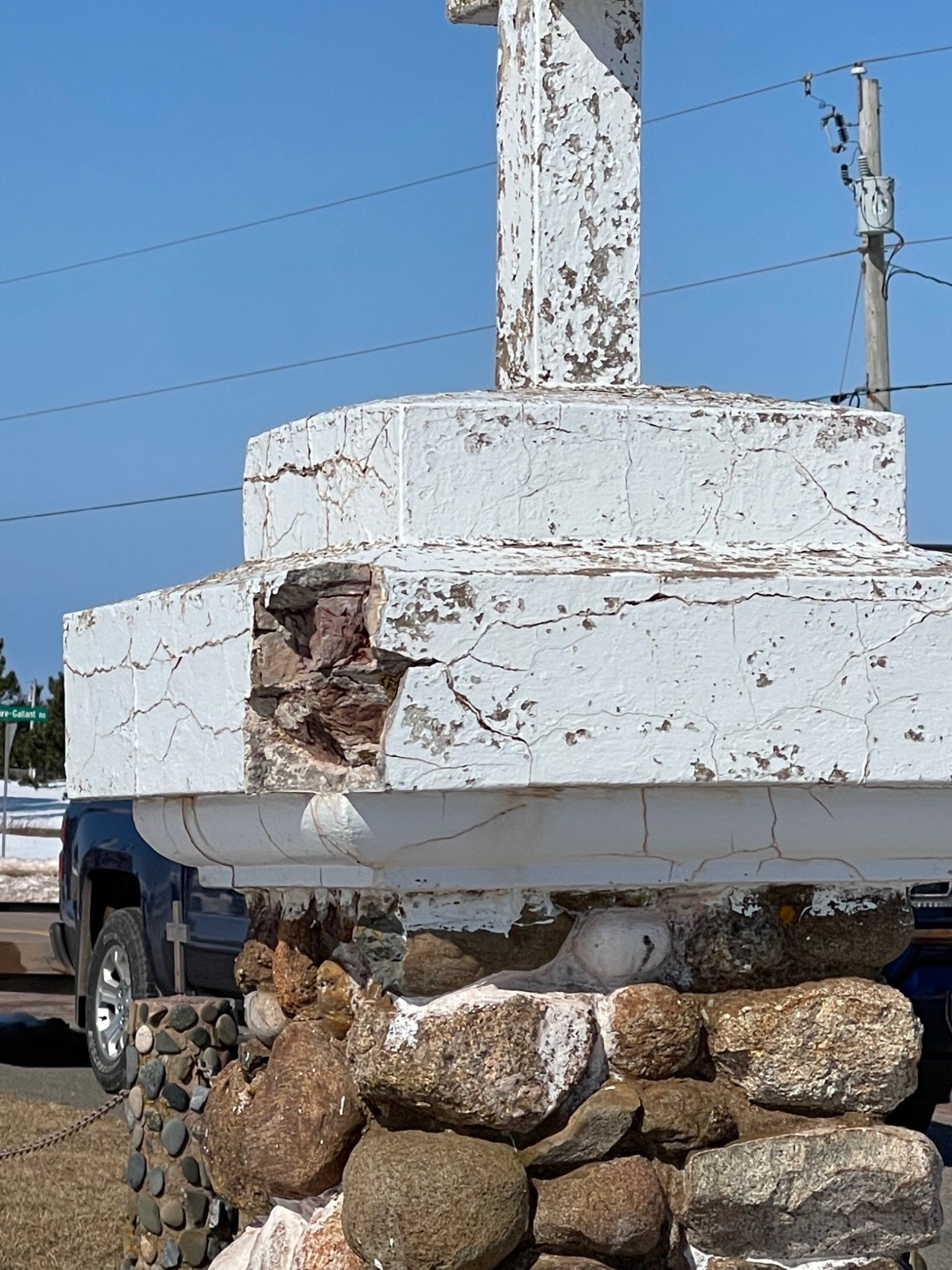
Water-entry zone: deterioration at the coping-to-stone transition was part of the moisture problem.
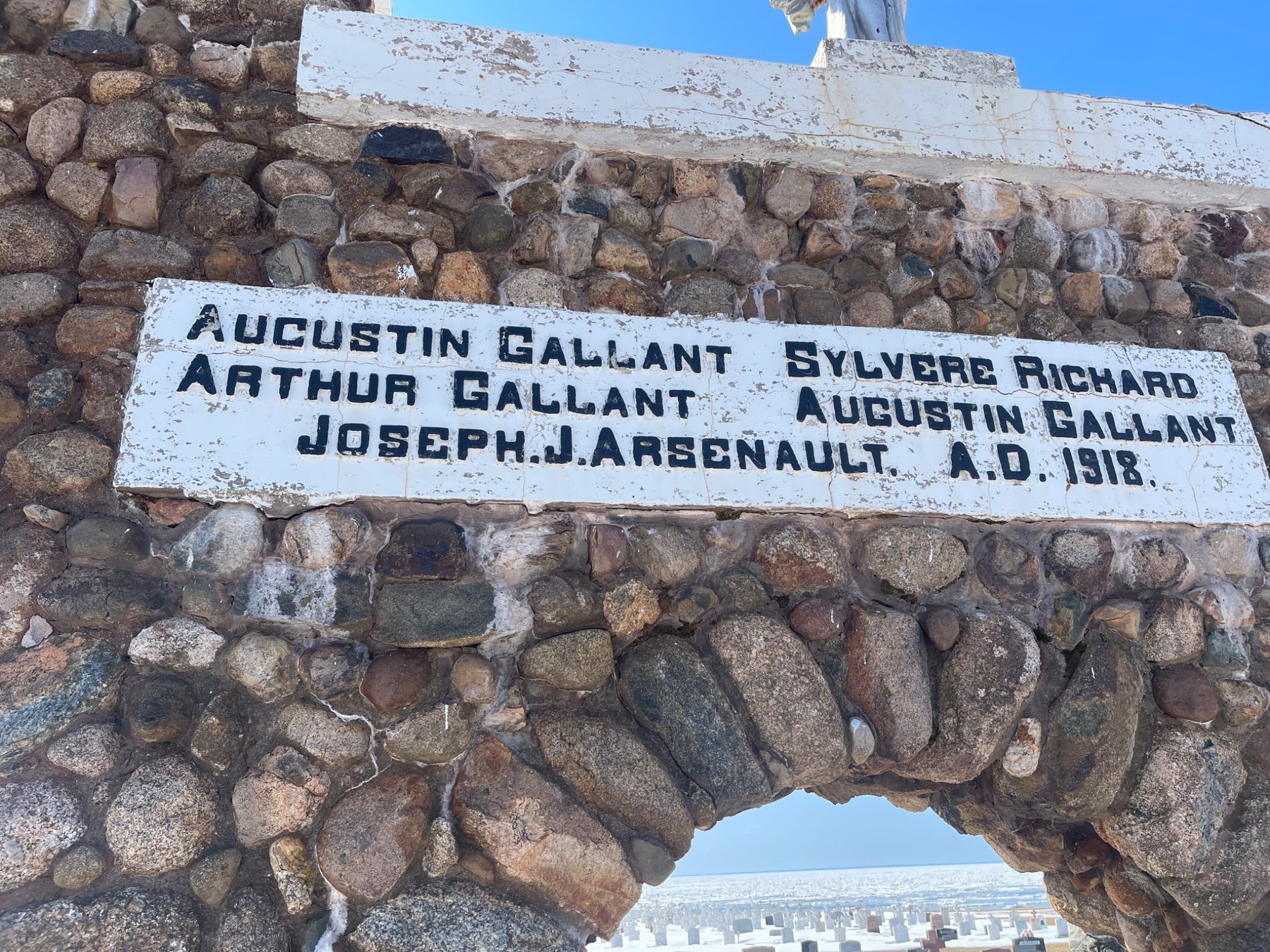
Memorial significance: the cenotaph preserves the names of Mont-Carmel residents commemorated for service and sacrifice in the World Wars.
Veterans Affairs documents the principal arch as the Mont Carmel Veterans Monument. It was unveiled in August 1923 by Governor General Byng of Vimy. The trumpeting angels and cross were added in 1927, and a centre plaque was later added for those killed in the Second World War.
The monument's masonry repair therefore had to protect both the physical structure and the commemorative elements attached to it. Work around the memorial plaque was carried out as part of the broader restoration, alongside cleaning and repainting of the statues and coping elements.
The restoration was supported through parish and community fundraising, with the Royal Canadian Legion helping launch the campaign with a $7,500 contribution.
The 2023 campaign was organized by Notre-Dame-du-Mont-Carmel Parish and the Comité historique Sœur-Antoinette-DesRoches as the monuments entered their centennial period. Public campaign material described the monuments as an important part of Acadian heritage on Prince Edward Island and beyond.
The available restoration budget was limited relative to the amount of heritage work involved. DinoMac therefore donated a significant amount of labour and time so the project could move forward. The monuments' importance to Mont-Carmel made the work more than an ordinary commercial contract.
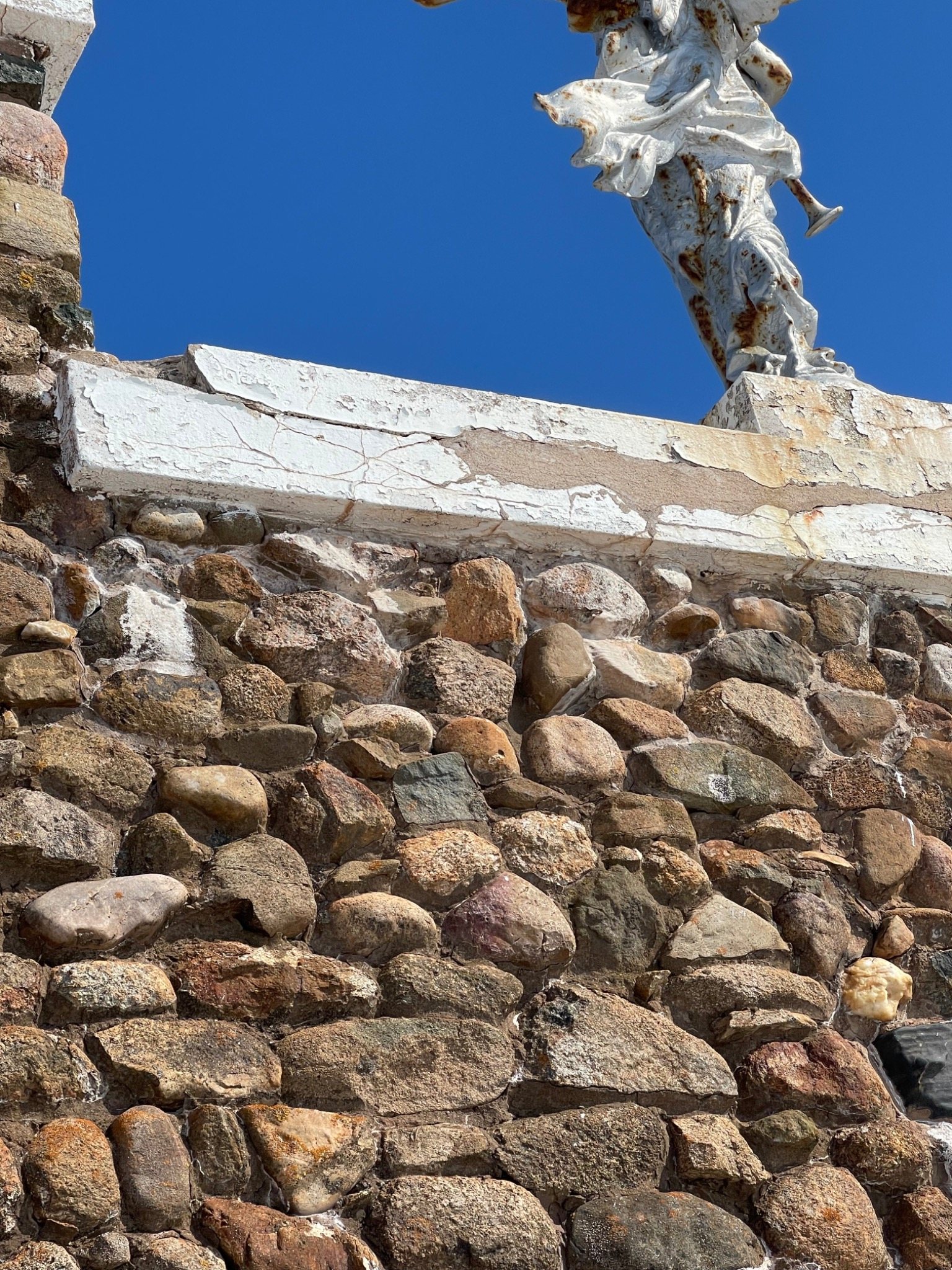
Repair in context: preservation meant dealing with hidden moisture and structural weakness while retaining the distinctive original fieldstone work.
Original fieldstone was treated as heritage fabric to be retained and reused rather than discarded for convenience.
Lime-based coping repairs were selected to match the character and material behaviour of the historic elements.
Stainless anchors and spiral helical ties added discreet reinforcement without visually modernizing the monuments.
Internal voids were filled so the repair addressed washed-out material within the monument, not only its exterior face.
Sealant at vulnerable stone-to-coping transitions reduced a recurring pathway that had contributed to internal deterioration.
Fundraising, Legion support and donated DinoMac labour all formed part of keeping the restoration achievable.
Public sources support the historical context, community campaign and DinoMac's role. The detailed repair methods on this page are drawn from DinoMac's field records and project photographs.
Coverage of the 2023 restoration campaign identifies DinoMac as the restoration mason, describes the fieldstone monuments and records the parishioner-supplied origin of the stones.
Read the campaign coverage →The English campaign release documents the three arches, mausoleum, Cajétan Arsenault, DinoMac's commission and the Royal Canadian Legion's $7,500 launch contribution.
Read the campaign release →The National Inventory of Canadian Military Memorials records the cenotaph's 1923 unveiling, its builder Cajétan Arsenault, later angel and cross additions, and the World War memorial plaques.
View the memorial record →Send wide photographs, close-ups of failed mortar or stone, and any information you have about the age, original materials and previous repairs. Heritage masonry is easier to plan when the existing construction is understood before removal begins.
Prepared by Dean MacArthur, DinoMac Masonry Ltd., a third-generation mason with more than 20 years of hands-on masonry experience.
Historical context is supported by the external references above. Repair-method descriptions, material choices and project photographs are drawn from DinoMac's direct involvement in the restoration.
Reviewed August 26, 2026.
For DinoMac's primary featured heritage case study, see the sandstone, mortar, water-management and fireplace restoration work at Dalvay-by-the-Sea National Historic Site.
Read the Dalvay Case Study